Why Pipes Burst in Lakewood's 1950s Homes
Lakewood grew up fast in the early 1950s, and much of the plumbing installed then is still in the walls. Here is why those pipes are bursting now, and what owners of older homes can do.
A 1950s line can go from fine to flooded fast. One call gets help on the road to you.
Call (562) 245-5416 Request ServiceLakewood's 1950s building boom
Lakewood as we know it was built in a burst of postwar construction between 1950 and 1953, when 17,500 houses went up in less than three years, according to the City of Lakewood's own history. That history is a point of pride, and a plumbing reality check. The City of Lakewood site covers local history, permits, and water service information for the area.
The water lines installed during those years were meant to last decades, and many have. But they were never meant to last forever. In homes that still carry original plumbing, the pipe walls have now been in service for more than 70 years, corroding from the inside out the entire time. When those lines fail, they rarely drip politely. They burst.
Galvanized steel: at the end of its service life
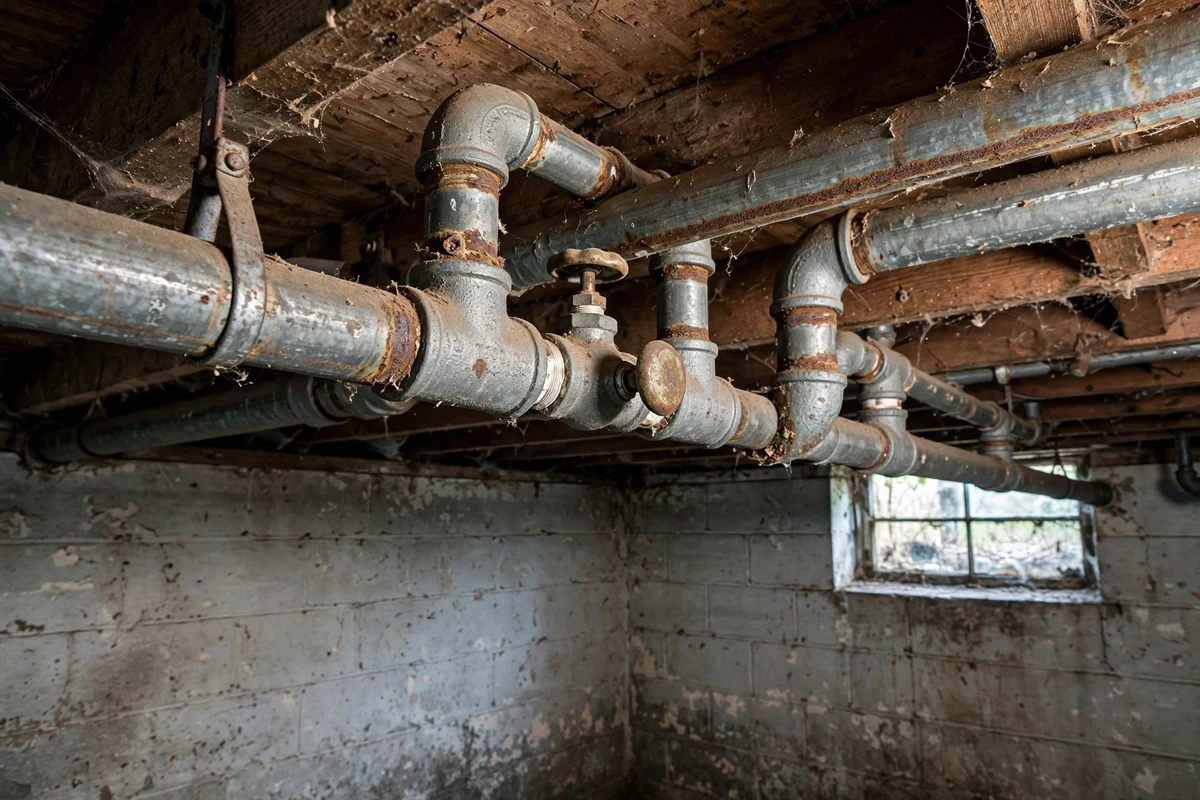
Galvanized steel was the standard supply-line material for much of Lakewood's 1950s construction.
The zinc coating that protects galvanized pipe breaks down over time, and then the steel itself starts rusting from the inside. The interior walls narrow with scale, water pressure drops, and the pipe walls grow thinner and more brittle year after year. Eventually a weak section gives way, sometimes as a pinhole leak, sometimes as a full burst.
If your home still has original galvanized lines, the practical answer is not another round of spot repairs. Galvanized pipe replacement removes the aging steel entirely and replaces it with modern piping built for the long haul.
Copper and cast-iron lines are not immune either
Not every 1950s Lakewood home has galvanized pipe. Copper supply lines and cast-iron drain lines show up too, and they have their own aging patterns.
Copper pinhole leaks
Copper resists rust, but it can develop pitting corrosion, tiny pits that grow into pinhole leaks. Water chemistry and high velocity flow wear at the pipe from within. One pinhole often means more are coming, which is when copper pipe repair or targeted replacement enters the picture.
Cast-iron drain lines
Cast iron was the drain-line workhorse of the era. It corrodes and scales internally over the decades, narrowing until drains slow and bellies form. Cast iron does not burst like a supply line, but its failure modes, cracks, channeling, and collapse, are just as disruptive.
Mixed-material systems
Decades of partial repairs leave many Lakewood homes with a patchwork: galvanized here, copper there, maybe a PEX run from a remodel. Every junction between different metals is a potential weak point, because dissimilar metals can accelerate corrosion where they meet.
High water pressure finishes the job
Age weakens the pipe. Pressure breaks it. Many Lakewood-area homes sit on water service that delivers pressure well above what aging 1950s plumbing was designed to handle comfortably.
High pressure hammers every joint, valve, and corroded weak spot each time water moves through the system. It turns pinholes into splits and splits into bursts. It also shortens the life of water heaters, washing-machine hoses, and fixture valves, the whole system bears the strain.
The fix is straightforward: a water pressure regulator installed on the main line holds your home's pressure steady at a safe level. For older homes with original plumbing, it is one of the simplest protective upgrades you can make. The U.S. EPA’s WaterSense guidance on aging plumbing and household leaks covers the same warning signs.
Ground movement and shifting soil
Lakewood's soil and seismic setting add a mechanical stress that aging pipes handle poorly.
Soil settles and shifts over decades, and every tiny movement tugs at rigid pipe runs, especially lines buried under slabs and yard service lines. Add the minor earth movement Southern California is known for, and brittle 70-year-old pipe takes repeated mechanical stress on top of corrosion. Rigid galvanized and cast iron handle that flexing worst of all, which is one more reason original lines in 1950s homes fail when they do.
What owners of older Lakewood homes can do
You do not have to wait for a flood to find out what your pipes look like. Here is a sensible plan:
- Get your pipes identified and assessed. An inspection of exposed lines, under sinks, at the water heater, in the garage, tells you what material you have and what shape it is in. If you have symptoms like low pressure or rusty water, add leak detection to find trouble spots you cannot see.
- Check your water pressure. A simple gauge reading at a hose bib tells you whether pressure is stressing your system. If it runs high, a regulator protects everything downstream.
- Plan replacement on your schedule, not the pipe's. When original galvanized lines are near the end, galvanized pipe replacement or whole-house repiping resets the clock on your schedule, instead of in the middle of the night after a burst.
- Know your shut-off valve. Until replacement day comes, the cheapest protection takes minutes to learn: every adult in the house should know where the main valve is and how to turn it.
Call Lakewood Pipe Rescue at (562) 245-5416 and tell us your home's age and what you are seeing. We will tell you honestly what your pipes need, and what they do not.
Frequently asked questions
Questions about aging pipes in Lakewood’s mid-century homes.
How long do galvanized pipes last in a Lakewood home?
Galvanized steel lines often show serious internal corrosion after roughly four to five decades. Lakewood’s 1950s homes are well past that mark, so original galvanized pipes still in service are living on borrowed time.
My 1950s Lakewood home still has original pipes and no problems. Should I worry?
There is no need to panic, but there is reason to plan. Pipes corrode from the inside, so they can look fine right up to the day they fail. If your lines are original galvanized or old copper, an inspection tells you how much life is left and lets you repipe on your schedule instead of after a flood.
Is repiping really necessary, or can I just fix leaks as they happen?
Spot repairs make sense for an isolated problem in an otherwise sound line. But when pinhole leaks and corrosion keep returning, each new repair brings more disruption while the rest of the system keeps aging. At that point many homeowners choose whole-house repiping to reset the clock.
Does high water pressure really damage pipes?
Yes. High pressure hammers joints, valves, and weak spots every time water moves through the system. A regulator holds pressure steady and is one of the simplest ways to protect aging lines.
Can a plumber tell what kind of pipes my home has?
Yes. An inspection of exposed lines, under sinks, at the water heater, in the garage, identifies the material quickly, and leak detection tools can confirm the condition of lines you cannot see.
People Also Ask
How can I tell if my 1950s home still has original plumbing?
Look at exposed pipes near the water heater, under sinks, and at the main valve. Galvanized steel looks dull gray with threaded joints, while copper is reddish-brown with soldered joints. If the visible runs are original material and no repipe permit or invoice exists for the home, the hidden runs are very likely original too.
Do 1950s Lakewood homes have slab foundations that hide leaks?
Many do. A large share of Lakewood's postwar homes sit on concrete slabs, with water lines running under or through the slab. A leak there may show only as a warm floor patch, a rising bill, or dampness at the slab edge. That hidden path is why slab leaks in older homes often run longer before anyone notices them.
Why do 1950s pipes fail now instead of twenty years ago?
Corrosion is cumulative. Galvanized zinc coatings protected the steel for decades, then wore through, leaving bare steel to rust from the inside. Wall thickness that was adequate twenty years ago has kept thinning ever since. Age, pressure, and ground movement eventually combine at the weakest section, and that is when a line that survived for decades finally gives way.
Contact Lakewood Pipe Rescue
Reach out any time. We aim to answer promptly and get help moving as quickly as we can.
Call
(562) 245-5416
Emergency line, call any time.
Visit
4400 Ladoga Ave
Lakewood, CA 90713, USA
contact@burstpiperepairlakewoodca.com
We aim to reply within one business day.
Prefer to talk it through?
Call and describe what you're seeing, water where it shouldn't be, a hissing wall, a sudden pressure drop. We'll tell you the safest next step before anyone rolls a truck.
Call (562) 245-5416