How Plumbers Find Hidden Pipe Leaks
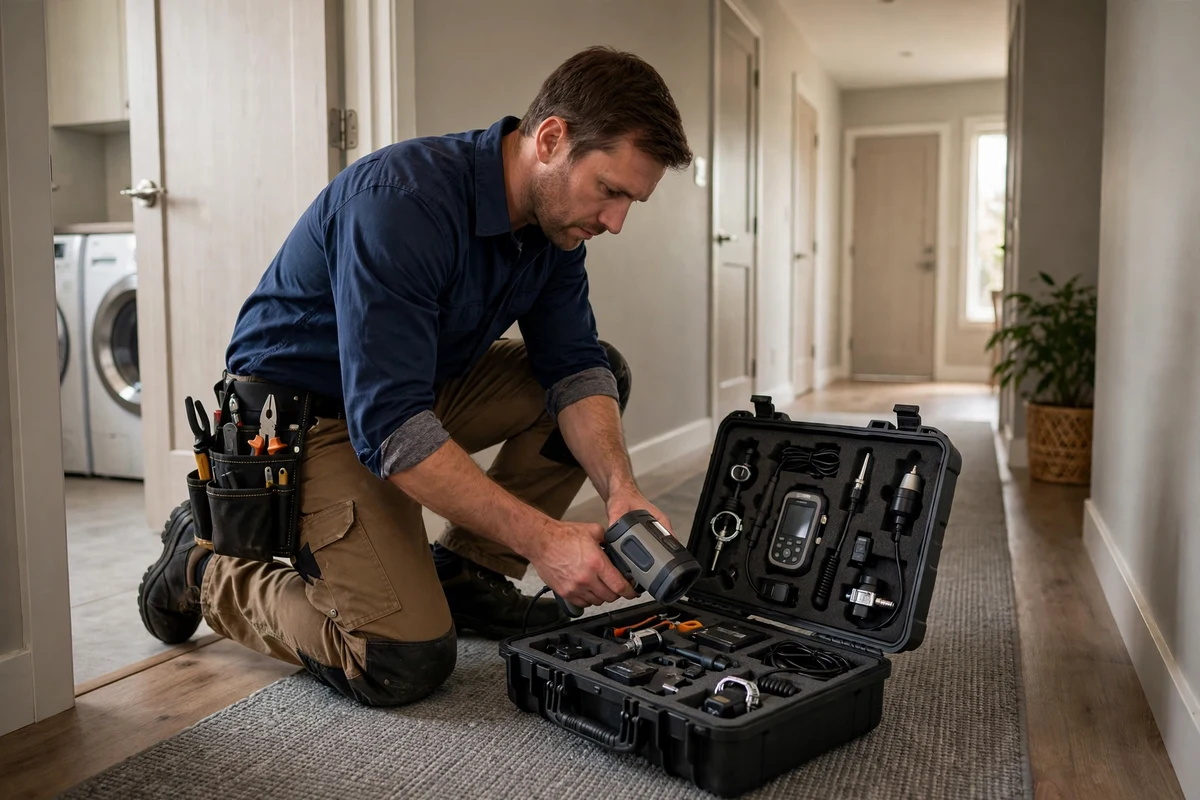
The leak is inside your wall, and the wall is staying put. Here is the actual toolkit plumbers use to find water you can’t see, and why each tool exists.
A hiss in the wall, or a patch that stays damp? Call us and describe it — we’ll help you pin down the cause.
Call (562) 245-5416 Request ServiceWhat the tools can’t do
Straight talk: no tool sees through everything, and anyone who says otherwise is selling.
- Thermal cameras need a temperature gap. A line sitting at room temperature in a room-temperature wall won’t show much of a pattern.
- Acoustic gear fights background noise. A busy street, a running appliance, or rain on the roof can mask a small leak’s sound.
- Moisture meters read the damage, not always the source. Water travels along framing and pipes, so the wettest spot isn’t automatically the break.
- Cameras need access. If there’s no cleanout or entry point near the suspect section, the camera can’t get in without opening something first.
That’s exactly why technicians cross-check with two methods before cutting. If you’d like the full visit, detection plus the repair in one trip, see our burst pipe leak detection service. The U.S. EPA’s WaterSense guidance on finding and fixing household leaks covers the same meter and listening checks, and the City of Lakewood site lists local water service and permitting information.
Leak detection questions, answered
What homeowners ask before booking a detection visit.
Can I find a hidden leak myself with a store-bought detector?
You can spot symptoms, an inexpensive moisture meter finds wet drywall just fine, but pinpointing the break before opening a wall takes the acoustic and thermal gear plus practice reading it. Most DIY searches end with extra holes and the same leak.
Do plumbers have to cut open my walls to find a leak?
Not to find it. The whole point of the toolkit is to locate the leak first, so only one small opening is needed, right at the break. Cutting first and searching second is backwards.
Which tool finds a slab leak?
Usually a combination: acoustic listening to hear the leak under the concrete, then thermal imaging to trace the warm or cool patch on the slab surface. Moisture meters confirm conditions at the edges.
How accurate is leak detection?
When a technician cross-checks with two methods, say, acoustic plus thermal, the marked spot lands very close to the actual break. Single-method guesses are the ones that miss.
Will detection work if my leak is tiny?
Small leaks are harder to hear and make smaller temperature patterns, but moisture meters and a patient acoustic sweep still pick them up. It takes longer than finding a gusher, not different tools.
When a pipe bursts, every minute adds water damage. Call, describe what you’re seeing, and we’ll send a technician to your door.
Call (562) 245-5416People Also Ask
How long does a leak detection visit usually take?
Most detection visits take an hour or two, depending on how many suspect areas need checking and which tools are required. A single damp wall may be traced quickly, while a hidden slab leak can need acoustic listening, thermal scanning, and meter checks together. The visit ends with a located leak, not just a guess.
Can leak detection find a leak under a concrete slab?
Yes, slab leaks are a standard detection job. Acoustic sensors listen for the sound of water escaping under the concrete, thermal cameras look for warm patches from hot-water lines, and meter tests confirm water is moving with everything off. Combining two methods narrows the spot so any opening in the slab stays small.
Why do plumbers check the water meter during leak detection?
The meter is the simplest proof that water is moving when it should not be. With every fixture, appliance, and outdoor tap shut off, a meter that keeps turning means a leak somewhere in the system. That single check separates a real hidden leak from a damp patch caused by condensation or a one-time spill.
Contact Lakewood Pipe Rescue
Reach out any time. We aim to answer promptly and get help moving as quickly as we can.
Call
(562) 245-5416
Emergency line, call any time.
Visit
4400 Ladoga Ave
Lakewood, CA 90713, USA
contact@burstpiperepairlakewoodca.com
We aim to reply within one business day.
Prefer to talk it through?
Call and describe what you're seeing, water where it shouldn't be, a hissing wall, a sudden pressure drop. We'll tell you the safest next step before anyone rolls a truck.